
Interview with Paul ANDREW
the ephemera interviews
In this series of interviews, oral histories artists and written reflections artists directly involved in ARIs and artist-run culture 1980- 2000 speak about the social context for their art making and provide insights into the ephemera they produced or collaborated on during this period. Artist ephemera includes artworks, photocopies, photographs, videos, films, audio, mail art, posters, exhibition invites, flyers, buttons and badges, exhibition catalogues, didactics, room sheets, artist publications, analogue to digital resources and artist files.

BIO
Paul Andrew (b. 1964, Magandjin Brisbane) is a queer activist, artist researcher, senior media artist, filmmaker, video artist, zinester and artist curator with experience in social practice, site-generated ephemeral practice, creative archival assemblage and media art making using remix, performance, bricolage, collage and punk-informed DIY cut, copy, paste techniques. Their current practice explores increased potential for creative archival assemblages through artworks, exhibitions, installations, publications. Multimdimensional cultural forms which combine varied archival materials, such as documents, images, and personal effects held in private and public coillections, to create affecting narratives, transmit new meaning and trouble historical narratives.
The artist notes that the semi-structured interview, oral history and written approaches used with ARI Remix affords them an opportunity to do self-interviews as a form of testimony in this digital context.
extra zine issue # 119
Interview with Paul Andrew – Scale from the Pink Brush
Image: Scale from The Pink Brush Colour Group Series 1985-88, so many ephemeral and performance art activities and art works were shaped and informed by the actual ARI spaces we used and made together.
An Interview with Paul Andrew
30 March 2015 [recast 2025-26]
the ephemera interviews
In this initial ARI REMIX series of stories, photo essays, oral histories and interviews, artists of local renown directly involved in ARIs and artist-run culture 1980- 2000 speak about the social and biogeographical context for their art making and provide insights into the community-based Ephemeralities they produced or collaborated on during this period. Artists’ ephemera digitized and recast here includes artworks, photocopies, photographs, videos, films, audio, mail art, posters, exhibition invites, flyers, buttons and badges, exhibition catalogues, didactics, room sheets, artist publications, analogue to digital resources and artist files.
Artists involved in Queensland/Australian ARIs 1940 to Now play an important and ongoing role as artist archivists, collectors of artworks and other primary resource materials. Their collections are hidden and ‘at risk’ and are safeguarded independently and outside formal, traditional, or mainstream institutions. These collections are not easily accommodated into traditional archival systems.
ARI Remix is conceptualised as a rolling internet artwork. According to the definition used by Rhizome, “internet art” (or “net art”) is “art that acts on the network or is acted on by it”. This commonplace definition encompasses a wide range of multimodal artistic practices that are intrinsically bonded to the internet, either as a medium, subject, or platform. It can include anything from browser-based works and software art to more informal practices like social media posts, and its meaning is defined by what it does rather than solely by its form. Here, I employ it as a ‘living archives’ and community-based archival space.
Presented in both online and offline settings as a living archives as archival art initiative; LGBTQIA+, cis, non-binary, trans, gender diverse and BIPOC inclusive, and involving active participation and collaborative collecting engagement by artists, arts workers, co-creatives, peers, and artist groups. It is an enthusiast-led, community-based, non-profit and art ephemera study resource and Web 2.0 internet artwork #ari_remix. It is made entirely possible through immense kindness, generosity, volunteerism, and collaborative collecting efforts of over 600 Queensland/Australian artists, 500 ARIs and significant arts philanthropy.
ARI Remix Artist and DIY community facilitator,
Paul Andrew
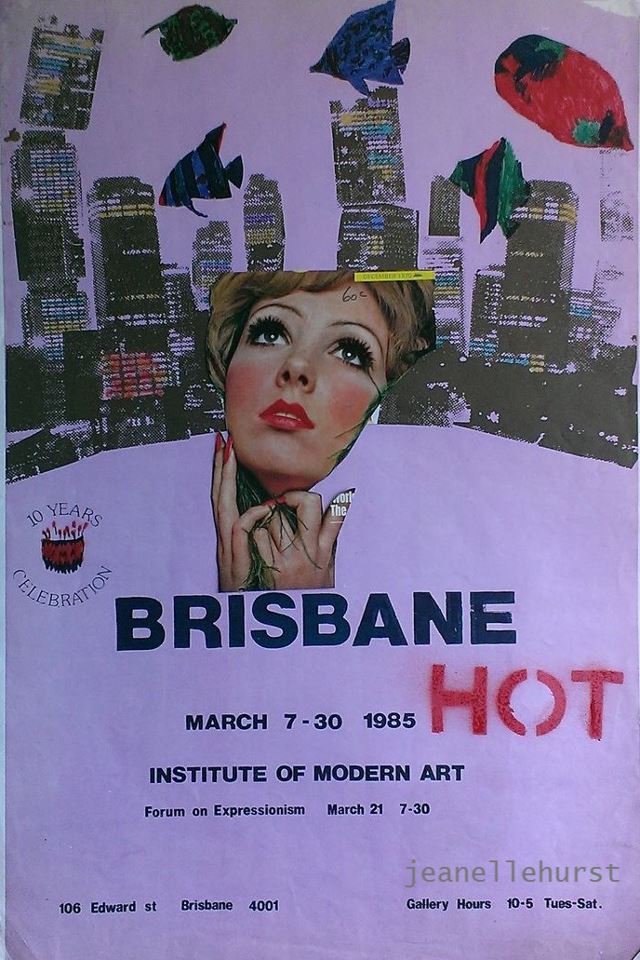
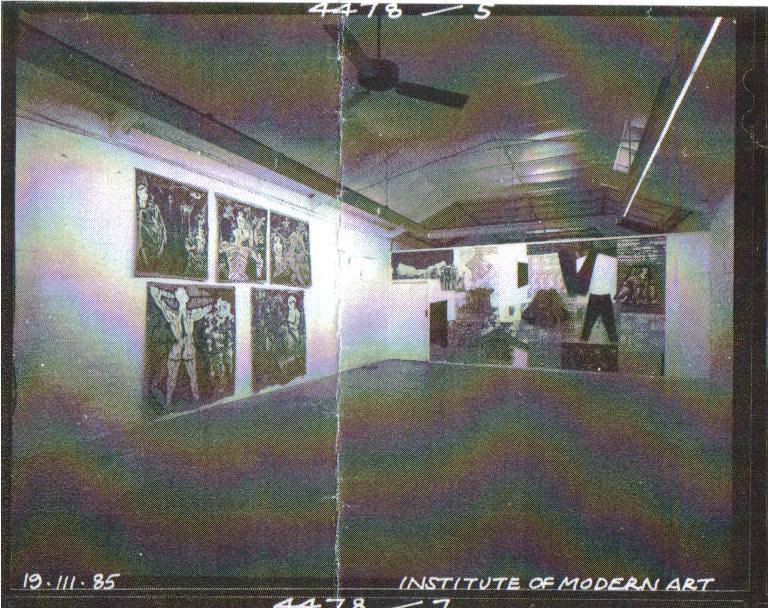
Brisbane Hot : Institute of Modern Art : March 7-30, 1985. [partial catalogue list]. (1 folded sheet, [4] p.). Notes : Curated by IMA Director Peter Cripps. Artists represented were Paul Andrew, Maria Cleary, John Boundy, Chrissy Feld, Joe Furlonger, Ranna Hale, The Oflate Group (Adam Boyd, Jeanelle Hurst, Russell Lake, Zeliko Maric), Scott Redford, John Waller
BIO
Paul Andrew (b. 1964, Magandjin Brisbane) is a queer activist, artist researcher, senior media artist. Paul’s creative practice is multimodal. They explore diverse forms and artistic roles encompassing filmmaker, video artist, zinester and artist curator with experience in social practice, remix, performance, bricolage, collage and bricolage techniques. Their practice scopes increased potential for creative archival assemblages through artworks, exhibitions, installations, publications. This work yields cultural forms which combine varied archival materials, such as documents, images, ephemera and personal affects held in private and public collections, with the aim to create affecting narratives, transmit new meaning and trouble existing historical narratives.
The artist notes that the semi-structured interview, oral history and written approaches used with ARI Remix ‘ephemera interviews’ affords them an opportunity for people to do self-interviews – with their own questions and answers in their own words – as a form of testimony in this digital context.
PA:
Thanks for your time today, the early to late 1970s and early 1980’s Queensland /Brisbane Social History, what sort of world was this Queensland for you?
PA:
I started my schooling in 1969. I was aged four, a little younger than other students. In the 1970s I was at primary and secondary school. I graduated from High School in 1980, and in 1981 I began a Bachelor of Law course at Queensland University of Technology, then called the Queensland Institute of Technology.
My experience of Brisbane’s bohemian and punk post punk new wave art scene was in a sense, an opening up to the more pluralised real world around me. The world of artists and artist communities in the 1970s and 1980s was one very different to the one we were told about by ‘the state’ and the then Queensland Premier Joh Bjelke-Petersen.
This knowledge was partly shaped by my parents, grandparents, aunties, uncles and cousins older than me, and was also informed by insights I gained by joining a number of independent artist groupings including the Ferny Hills Art Association, the Northside Creative Artists Association, the Brisbane Institute of Art founded in 1977, Mervyn Moriarty’s Art School in Enoggera Terrace and in 1977 I became an ongoing member of the Institute of Modern Art and became a regular visitor to the Ray Hughes Gallery, Cintra House and the Verlie Just Town Gallery in Queen Street. Verlie Just was like an aunty, as was artist and colourist Irene Amos, this a place where my much-adored art teacher and mentors Irene Amos exhibited her work. As a young person I was always meeting so many wonderful people older than me, they generously shared stories, many stemming back to the 1940s and beyond.
I had been making art, collage, painting, zines, woodwork, and craftivism since I was a child. When I wasn’t making art, and craft, I was making assemblages in the garden and growing native plants with my mum. Native plants were trending in popular culture at the time. This was the 1970s. This was also a natural inclination, and I was fervently supported by my parents. My mum was an ardent dressmaker, crafter and painter, my Dad a carpenter and joiner. This is true of my grandparents and grandparents too, who were all creatives, adopting many forms for artistic explorations. So, my younger artist years were a rich terrain of learning, making, doing, adopting, adapting and learning. I showed my work regular at the Northside Creative Artists’ exhibitions, and began making brunaille paintings of family archives, these included depictions of picnics safeguarded in my grandmother’s 1920s photograph album when she was around my age.
Like many of my artist friends and peers who grew up in the northern suburbs in the 70s, I too was raised in an ultra-fearful, homophobic, racist, misogynist, conservative, and xenophobic climate. My parents formed part of the earlier generation groomed by austere and traumatic depression, war, and post-war years experiences. While we, in the 1960s and 1970s were children of the revolutionary counterculture, with our parents slowly emerging from their post-war experiences, whereas our interests and aims was a sense of ‘following our weird’.
My parents were often accommodating to my youthful difference, defiance and deference, initially at least, they were part of the Australian Labour Movement, my dad’s side of the family were members of the Queensland/Australian Trade Union movement, my Dad’s maternal grandfather was a dockside worker at Eagle Street Wharves for many years, and this union sensibility was designed for workers and workers families and extended families to organise, take action and implement change processes and workplace change.
I had learnt from an early age that to organise, collectivise and act/enact other with other people can trouble the status quo. I was fortunate to benefit from a good academic education and admiration from my family for my artmaking, that is, at least, until it came time for me to choose a career in 1980.
Becoming an artist in the late 1970s was considered an indulgence, a whim, and not a necessity. While a challenging time followed, leaving Brisbane in 1984 and 1988 to explore the queerer worldmaking beyond Brisbane’s suburban backyards, and eventually ‘for good’ in 1989 was only a matter of time.
Like many queers in Queensland in the 1970s, I felt alone and lonely. Escaping from ‘Queensland: Ugly One Day, Horrid the Next,’ to the accepting and caring southern climes where Australian queer-trans, LGBTQIA+ activism was gaining momentum in unprecedented ways, was life changing, liberating, and enervating.
Before this Brisbane significant break-away time, my parents allowed us an astonishing opportunity to travel widely, deeply and explore Queensland and New South Wales centres and regions in the 1970s, as much as the family budget permitted when we were growing up. There was so much joy in those initial two decades of my life. I am so grateful we all got to experience the inky night skies, when there were only stars and celestial bodies, not satellites, drones and weather devices. I am from a family of ancestors who were storytellers, makers and where memories where not simply embodied, they were connected to communities, places and space, and this mindset continues inside me as an eternal flame.
They took us here and there, everywhere, on road trips, boat excursions and picnics every week, and they whisked – me, my brother and sister – on a road trip to Sydney in 1978 for a totally brilliant extended summer vacation, ‘to live in Sydney for a bit’ , sooo Incredible. It was where I experienced aspects if the post-war Bohemia and counterculture of Sydney as we drove around suburbs like Woolloomooloo and the very queer before queer Frank Watters Gallery, Kings Cross, Potts Point, Darlinghurst, Bondi and witnessed the Punk and Skinhead cultures and gay and lesbian cultures for the first time. Breathtaking to witness, alternative people everywhere, in the daytime, and on the streets, in droves. It was nothing like Brisbane at all. My parents loved taking us to galleries, libraries, archives and museums, but in Sydney these memory places seemed both unfamiliar and even more bedazzling.
Sydney beckoned for many years since that time, and in 1989 I left behind Brisbane and called Sydney home. I was living in a fabulous share house in Enmore with artists, hairdressers, hippies, Brisbane exiles – the Peanut diaspora as we used to say – it was a revolving door of artists, activists and bucket bong smokers, and here I found an old dusty green EJ Holden Station Wagon, which I restored and named Lenny [after Lenny Kravitz] .
In March 1989, I started work as a curator at the Australian Centre of Photography and began doing more with my Super 8 filmmaking skills and began learning analogue video production at Metro Screen nearby on Oxford Street. At the time the ACP was doing radical things with curating video art and photo media – much to the chagrin of many realist photographers who founded the gallery almost 15 years earlier- and collaborating with Brian Langer and Amanda Crowley at The Australian Video Art Festival, for me, well it was a palpable sense of what the present and the future held, a more artful, technological and queerer media future. I still live in hope!
This exciting decade of ‘Emerald City’ ; living and working in Sydney were HIV AIDs and LGBTQIA+ activism was commonplace, was preceded by a formative artistic period in Brisbane from 1977 to 1989 when I became an active member of the newly developing artist-run culture and community-based activism.
At this time, Brisbane Queensland queer and trans was often covert and becoming less so. It was during the Bjelke-Petersen years when there was no arts infrastructure, no allyship with marginalised people or communities, there was nothing that grabbed young people’s interest or involvement. There were no ARIs and no artist run ecosystem like we know and admire now. The Queensland AIDs Council was established with amazing community and beats outreach – beats were common meeting places for gay and queer people – in 1985-1986.
Yet, somehow as young people determined to work against the odds, and through concerted efforts, energies, and synergies we made all that happen quickly and intensively.
We instigated an explicit and not covert ARI community by activating spaces, we sustained that through many collectivising actions, both independently, voluntarily, and outside the mainstream arts ecology. Together we established the Queensland Artworks Alliance and Eyeline Art Magazine in 1986. Amazing what ARI sparks and collectivising can ignite and achieve. In fact, making ARI Remix, is a digital way to remind artists that they are not reinventing the wheel, they are supported by and connected with SEQ/Qld ARIs across time.
We were fortunate to have support from arts organisations like the IMA, and many academic and scholars at University of Queensland and Queensland College of Art. In particular colleagues like Urszula Szulakowska, Graham Coulter Smith and Nick Zurbrugg, the troika of change agents who helped to put young artists and ARIs on the map, well that’s what we felt at the time, we felt respected, admired and supported in a climate where there was no support. We were afforded so much opportunity in this evolving artistic climate where free will, autonomy and enthusiastically following our weird was actively embraced, supported, and respected.
One astonishing experience for me, as a young gay man – like hundreds of others living in Queensland – and accustomed to being bashed, bullied and belittled over two decades prior, was going to see the lifechanging feature film Clockwork Orange at the Blunt Focus Collective Cinema. An art and retroactive cinema located at the Brisbane Community Arts Centre in Edward Street, just over the road from the IMA where I worked as a gallery assistant for three years. It was run by a collective and coordinated by artist activist Brian Doherty who also ran a film program at the IMA for many years.
it was a disquieting but also a fabulously positive cinematic life moment. The film is about the loss of humanity, someone who is outwardly organic, and inwardly robot-like, a machine. A person stifled by external conditioning, so much so, they are morally disabled and unable to make a moral choice between good and evil . Sitting in the darkened cinema, a space filled with a raucous audience of punks, new wavers, skinheads and alternatives made a big impression on me. The film is about oddness, queerness and strangeness, though not explicitly about sexuality as such, in Brisbane where queer was often covert as I mention, it became a cult punk film in the city. On one hand, feelings were mixed, as I was a tad fearful that despite my punk sensibility, I would be bashed during the screening, or after leaving the cinema. However, on leaving was delighted to see that other Punk queers were also queerly engaged after the session, holding hands, kissing with fury, saliva and pogo dancing tongues.
This cinematic introduction to 1980s Punk/Skinhead phenomena had a much earlier iteration, when we were Punks, and Plastic or Plastique Punks [a nod to Plastique Bertrand] in high school, emboldened and inspired by 4ZZZ raw music programs played covertly on transistor radios, under pillows before going to sleep. The anarchic noise making of The Saints, Xero, The Leftovers, a soundtrack of cultural change awakening sleepy Brisbane into a changeling present. We were too young to leave home and venture into slipstream of anarchy. In 1977 I was aged 13.
I learned how to be punk, through style, dance and mindset in safe surrounds. At school dances, gatherings, theatrical productions and events. For example, the French and German language students would gather together for events at Kelvin Grove High School for Oktoberfest, Bastille Day and other language celebrations. We would perform, sing and dance the night away. One year Mum helped my sew a punk outfit, sequins, a dyed pink shirt just like Plastic Bertrand’s pink zippered jacket and my mum’s fetching deep forest green pants, spiked hair, 70’s punk rock mirrored wrap arounds. In a jiff of Dorothy, I painted, sequinned and upcycled an old pair of sandshoes into shiny silver tennis sand shoes, part sport, part disco, part punk…
Paul Andrew
PA:
“Punk Consciousness” when, how and where did that begin for you in Brisbane?
PA:
Two of my 1970s art punk role models were a lesbian couple in High School. We were all 12- to 14-year-old art students interested in painting, black and white 35 mm photography, zine making, the counterculture and diversity of subcultures, like punk, goth, electronica, pirate and community-based radio, art and television – anarcho dissonant media – scenarios. 4ZZZ was always there, if you kind find the AM frequency on the transistor radio.
I remember my two friends sitting in class piercing each other’s ears with a needle and inserting safety pins to adorn themselves, wiping away the blood from their mutual piercings – which matched their red-dyed hair- all cleansed with methylated spirits on cotton wall balls. This was in 1977. Miraculously, they never got caught by the schoolteachers, or maybe it was just because our ever-wonderful and ALT teachers just turned a blind eye.
Many of us refused our parents moral cautions about ‘filth on TV and radio’ and secretly listened to 4ZZZ in whatever ways we could. In 1979 and 1980, we started a school radio station, and informal collective of people with punk and new wave record collections. Dean Ervic and Colin Grimmer had turntables which were patched into the schools PA system and localised just outside the school library and assembly hall. This hot humid hub, was a place of art, culture, literature, readings, school magazine committee meetings, school disco dancing and fundraisers. Fundraising throughout the 1970s high school period, was all geared to raise money to buy the school’s first ever and terribly expensive computer. It had a special air-conned space in the geography block, a commodore- amiga-like desktop machine, purchased in May 1980. My brother made the most wonderful Soylent green video loops of airplanes and care flying in endless circles, going nowhere, with this new futuristic art machine.
My queer friends, while underage would magically get into punk bands and gigs at inner city and suburban halls, at the refec at UQ and QUT. We would pretend to go to the movies on Tuesday nights but would always go to The Terminus gay nightclub in Brunswick Street, we were all underage, and finally we had somewhere queer to go, clandestinely at least.
Bohemian Brisbane, punk Brisbane were all part of the region’s enduring counterculture, this anarchic irreverence was made manifest through art exhibitions, galleries like the Spring Hill Gallery and conversations with art teachers, mentors and schoolteachers. Chatting with elders and Quelders [queer elders] was always ennobling and empowering.
Paul Andrew
PA:
There is much ado about the impact of the Bjelke-Petersen Regime, “The Police State” years – the state sanctioned vice and corruption you touch upon now; tell me in some detail about the political climate for you during this period?
JH:
My parents were anti-jo, anti-Russ and all the national cronies and bigots, they were left-wing, social justice and politically conscious people, but only so far, prejudice and fear prevented them from understanding and empathising with LGBTQIA+ gender and sexual diversity. We watched all the street protests on the news, the television was the mediated form of protest we experienced as young people in the 1970s. Fortunately, at this time the broadcast media in Queensland was left wing in nature, so protests while not televised live, captured the spirit and groundswell of dissent. Dissent was a catalyst that ended of the far-right wing Bjelke-Petersen era and ushered in widespread anti-discrimination laws in the 1990-1991 period.
Before this time, when we were making 1980s and 1990s ARI cultures, many of us lived in fear of police brutality, of state-sanctioned violence, demonisation and vilification, and for many queers unlawful arrests, curtailing of civil liberties and wrongful imprisonments, police harassment, violence, entrapment, aboriginal deaths in custody and demonic sentencing laws.
In the 1981-1984 period, while studying law, I was working as an articled-law clerk inside a criminal law firm in George Street. Terry O’Gorman was one of the many solicitors, barristers and QCs we worked with, social justice, aboriginal legal aid and legislative changes were a priority for Brisbane labour lawyers of the time. A total inspiration. And it was interesting for me to go to Boggo Road Gaol and learn first-hand about the testimonies of young men who had been wrongfully imprisoned due to their peaceful and non-violent protests, trumped up possession charges, police harassment and entrapment charges at gay parties, parks, streets and events. Where meetings and parties in gay and lesbian houses were always fraught and meetings in public places with strong cultural traditions for First Nations people like Musgrave Park were also targeted.
In 1984, I left behind the law studies and frustrations of slow legislative change in Queensland forever, after saving up my dosh for three years [I earned $50 dollars a week then], I travelled to London and Paris to live there for six months, both to come out, to become weirder, to draw, paint, dance, and laugh, and to discover and explore the queerness on a much larger scale to that I witnessed a wee earlier in Sydney in 1978.
In December 1984, emboldened to move to Sydney, I travelled to visit my long-standing friend Jasmine Hirst, to visit Art Haus, Kelly Street Collective and Art Unit artist-run spaces in inner-city Sydney, to spend quality time at Frank Watters Gallery, show examples of my queer conceptual paintings to the Roz Oxley Gallery [as I had earlier with the Ray Hughes Gallery in Brisbane] – and to experience the major Picasso retrospective staged at the Art Gallery of New South Wales. Jasmine took photos of us at school in the 1970s, and one of me in my punk demeanour, somewhere in my collection. This trip gave me an insight into the squat culture of Sydney in Glebe, and Darlinghurst, one way to find and make a share home, and not pay rent!
In 1984 and early 1985, a synthesis of these and myriad other life experiences précised above led to a reset in Brisbane – and not Sydney or Melbourne as so many friends had done already- and truthfully, being back in Brisbane activated a renewed sense of collaboration and of increased coordination. I started work as a volunteer at 4ZZZ for three years, and in 1985 was accepted – with credit for law studies- into the Art History course at the University of Queensland where I could learn to become a curator and artist curator involved with collecting, collections and archives. It’s important to note at this time artists were not supported as artist curators, curating was something other people did. ARIs changed this, That Space shows like Local Colour curated by artist curator Dale Chapman, and Earlier Attitudes I curated are a couple of examples.
PA:
Tell me in some detail about what you witnessed of colleagues who were gay, lesbian or trans, what you witnessed about their coming out and what they experienced?
PA:
Going to the theatre with my mum was always a treat as pre-theatre, intervals, and post-theatre was where I witnessed queer Brisbane since the mid-70s. I joined the mailing list at the Spring Hill Gallery in Downing Street Spring Hill in the late 1970s and became a regular visitor to both the gallery, it’s afternoon openings and the Spring Hill Fair, these were daytime queer before queer spaces. I started going to the Terminus Nightclub in Fortitude Valley in 1978, it was Brisbane’s only meeting place for queer trans people at the time, before the beat opened in Wickham Street, and later Options and others in the mid to late 1980s.
Looking back now, I am fortunate my school and post school years was a place where important LGBTQIA+ friendships and allyships formed, many of us wierdos and queerdos found one another and strengthened our ties, actions and artistic bonds.
PA:
Tell me about your direct lived experiences around Bullying, Brutality, and Violence while living in Brisbane?
PA:
So many negative experiences throughout school, and since. In primary school I used to hold hands with one boy and holding hands with a boy was discouraged, and our boyish bond was always physically broken by male teachers. Bullying was rife, and like many of us who grew up in the 1970s the tales of woe, trauma, bullying, bashing, bruising, brokenness and terror are commonplace, as are the stories of the transformations of circumstances. Where agency, activism, self and collective determination afford LGBTQIA+ people, not to mention, where the euphoria of dancing was paramount, an assuaging balm for the queer-trans soul and spirit.
Of all the stories of horror I tell, now I remember a young guy in Kangaroo Point, he was about my age, 20 years of age then, and he randomly pulled me up on the hot concrete footpath, leveraged me up to his face so we were chin to chin, and I was very fearful. He was much taller than me, very muscly and fit , like a footballer, and he took offence to how much gothic black makeup I was wearing, and the mascara that I sooo loved splashing around my eyes and lips. He scanned my face up and down, side to side.
He dropped me down, grabbed me roughly by my black tee shirt, and looked me in the eye with utter disgust and disdain, ‘ you’re, you’re, you’re, you’re he stumbled endlessly, as he was trying to get his words out and articulate his despicableness, ‘you’re a mod, you’re nothing but a mod, a mod, you’re a mod’.
I was both relieved to fall out of his clutches, and to land into a rolling fit of laughter, and I think this behaviour surprised him and caught him unaware, as I was both enormously delighted to be called a mod – the 1960s punk precursors, and I said to him while laughing loudly, ‘No I am not just a mod, I’m a raving homosexual’. And with that comment, surprisingly he left me alone in the scorching afternoon sun and wandered slowly in the direction of Woolloongabba.
PA:
Kinship: a brief biography of your immediate family background?
PA:
I grew up in Arana Hills in the 1960s and 1970s, and in those times the hills could view the clocktower of Brisbane City Hall. I was born into generations of working-class families, when my mum returned to work part time as a teacher’s aide in 1975 at the Fortitude Valley primary School, added income meant that we had pocket money and increased spending on our education, school camps, and attendances at films, theatres and collecting books and magazines.
My father and his father were carpenters and builders, and their friends and families were the kinship circle around us. Families of Italian, Greek, Yugoslavian, Czech, Hungarian, Turkish, Aboriginal and many other cultural backgrounds. I had a Japanese aunty, Aunty Happy who was born in Nagasaki and who miraculously survived the 1945 atomic bomb drops in Hiroshima and Nagasaki and escaped to Australia. Aunt Happy indulged my interest in Japanese Cinema, Ikebana, Origami and dressing up as a Geisha and courtesan. My friends at school were from Anglo Chinese, Maltese, Irish, Aboriginal and Torres Strait islander families and many other cultural backgrounds, it was amazing to learn so much about the world and different cultural experiences, and to taste what was inside kids delish lunchboxes, every day in and out of the schoolrooms.
Dad was also an avid photographer and super 8mm filmmaker, Mum loved painting, dressmaking and drawing, and Mum’s Dad was a painter and from a family of lithographers and book-binders.
My grandmothers and aunties were all creatives and collectors, and their homes; while modest, were like 1940s and 1950s household museums, brimming with artworks, curios, Bric a Brac, studio photography and artefacts inherited, gifted and safeguarded from many generations of family members, friends and colleagues. Mum also did Homecare for many years in the early 1970s, and Mum and three of us would cycle to suburbs like Enoggera, Alderley, Newmarket to help mum care for the oldies, clean up do a bit of gardening and so on, and these amazing people I will never forget, all in their 80s, 90s and 100s, with homes, collections and photo albums reaching back to Victorian times, and places like Minjerribah when the bay area was all unspoilt by gentrification and was a labyrinth of salty oyster farms and teaming with schools of small rainbow fish.
Dad taught me a range of photography and filmmaking techniques, and a few building and carpentry techniques too. My taught me so many skills from painting to drawing, and both parents taught me collage and assemblage techniques. My interest in these approaches is lifelong.
One of my most joyful memories is escaping Brisbane in 1984. I scrimped and saved for two years to live and work in London and Paris. I arrived in London in Spring 1984 and found myself warm and cosy ‘under the arches’ in Heaven. A famous gay nightclub which opened in 1979, and it was there on one visited when I touched hands and fingers with the gender bending drag performer Divine who kindly reached out to me as she was singing on stage. Later in Paris I was lost in the Marais district in the 4th arrondisement and found myself inside a gay leather bar when the barman, who spoke English gave me a free brandy and explained where I could find a queer friendly hotel nearby.
This area, just near the Centre Pompidou art centre and in London, the Riverside Arts Centre were arts precincts which captured and ignited my imagination. In November 1984, with the help of IMA artist director Peter Cripps we held a public meeting at the IMA- then in Edward Street – and a series of artist-run spaces evolved in the following years, and decades.
Paul Andrew
The Observatory Collective, That Space, Breathing Concrete, John Mills National, a range of annexe and satellite spaces and Bureau are a few of the ARIs evolving directly and indirectly from a November 1984 IMA meeting. Convened by artist director Peter Cripps and me. We wanted to make something together that was very different to Q Space and Q Space Annexe, a private space founded by artist John Nixon for artists in Spring Hill, were didn’t want to be artful underground, covert or private, nor did we want to just exist via photo documentation and the allure and lure of the photographic, we need to be unruly, up front, and to explicitly change and re-write the city together. We did that through concerted efforts, persistence and continuous actions.
More about this next year, as we are working intensively now on the ephemeral traces group exhibition scheduled for the University of Queensland exhibition in April 2016. As an introductory analysis, both art project and process the show will foreground five key spaces that operated in Brisbane from 1982 to 1988: One Flat, A Room, That Space, The Observatory, and John Mills National. It will coincide with the Barjai and Miya Studio exhibition curated by Michele Helmrich which considers the radical history of influential artist collectives which emerged in Southeast Queensland in the 1940s post war era.
A core and very difficult challenge with these types of recuperative artist-run exhibitions is identifying artists, artworks, artists’ ephemera and primary resources which are currently preserved and held in both private and public collections. ARI Remix is a way to help access and identify artists working in the 1980s and who may have collection items we can include.
Like many people who have lost everything, me included, after a house fire, flood or natural disaster or the vexing journey of moving from and in between many share accommodation sites over many decades and the attrition of collections that this often necessitates. This loss, grief and disillusion about memories as something material we can actually hold in our hands – or did at some stage – is a factor impacting on ephemeral traces and how we can recast this activity both online and offline, and with what resource materials and affecting traces remains. However, parents and friends often play a vital role as keepers of memory, and for me, as I only have 12 marbig archive boxes of materials – the That Space Archives and other ARIs all mixed in with personal and family stuff 1977-1998 – surviving, fortuitously and fortunately my dear and beloved dad has kindly cared for and preversed for this marbig boxes for over 30 years, Thanks Dad, and this example of beneficent familial and paternal care and memory vigil, makes an internet artwork assemblage like ARI Remix possible.
When artists and ARI aficionados Peter Anderson, John Waller and I met to have an initial discussion about how to make ephemeral traces happen I remember mentioning that this type of recuperative and recasting work – across time and temporalities – is not just an art or art historical project, or a community archives or documentary archival project, it is always an emotional project.
I mentioned that I had googled info about artist-run spaces in Brisbane in the 1980s in 2011 and that only one search result online emerged, a fabulous 2006 article by the ever-amazing Danni Zuvela which articulated the iterative nature of Southeast Qld ARIs – https://www.realtime.org.au/housing-the-virtual-the-radical-the-displaced/
We aim to embrace and accommodate this iterativity and co-creativity across time and temporalities with ARI Remix and ephemeral traces, and hopefully other iterative projects to come.
Postscript 2020
Citation/Abstract Dissertation or Thesis
Amechan: The creation and packaging of identity
Ramsay, Lehan. University of Western Sydney (Australia) ProQuest Dissertations & Theses, 1999. 10309880.
This thesis is important to read in the context of evolving developments in ARI culture in Australia. This paper and the accompanying project Amechan explore the construction of ‘virtual’ identity on the Internet.
It is vital to note that the affordances of the Web 2.era and lower and reduced barriers to access have enabled the ARI Movement to become a local and global social and cultural phenomenon and movement. We have moved beyond ‘virtual’ identity with the affordances of Web 2.0 including online and offline features that enable user-generated content, social interaction, and collaboration, such as blogs, wikis, social networking and commentary sites. These affordances facilitate activities like communication, knowledge sharing, cultural heritage and creativity, shifting the web from a static information source to a dynamic, participatory and potentially cocreative platform for users, readers and artists. Key affordances include the ability to create and share “microcontent,” connect with others, and build and strengthen online and offline communities.
Andy People – Andy Warhol [Luke Roberts] with Paul Andrew, Artspace, Sydney c.1990
Brisbane Hot : Institute of Modern Art : March 7-30, 1985. [partial catalogue list]. (1 folded sheet, [4] p.). Notes : Curated by IMA Director Peter Cripps. Artists represented were Paul Andrew, Maria Cleary, John Boundy, Chrissy Feld, Joe Furlonger, Ranna Hale, The Oflate Group (Adam Boyd, Jeanelle Hurst, Russell Lake, Zeliko Maric), Scott Redford, John Waller
Poster by Oflate group and Jeanelle Hurst Brisbane Hot : Institute of Modern Art : March 7-30, 1985. [partial catalogue list]. (1 folded sheet, [4] p.). Notes : Curated by IMA Director Peter Cripps. Artists represented were Paul Andrew, Maria Cleary, John Boundy, Chrissy Feld, Joe Furlonger, Ranna Hale, The Oflate Group (Adam Boyd, Jeanelle Hurst, Russell Lake, Zeliko Maric), Scott Redford, John Waller
Brisbane Hot : Institute of Modern Art : March 7-30, 1985. [partial catalogue list]. (1 folded sheet, [4] p.). Notes : Curated by IMA Director Peter Cripps. Artists represented were Paul Andrew, Maria Cleary, John Boundy, Chrissy Feld, Joe Furlonger, Ranna Hale, The Oflate Group (Adam Boyd, Jeanelle Hurst, Russell Lake, Zeliko Maric), Scott Redford, John Waller
Sex/Object Artists’ Ephemera, 1987
Photo: Shared Camera – Sex/Object, Exhibition, 1987 Photo: Martyn Sommer 1987
AXIS ART PROJECTS, 1988 documentation of Times Square Public Art
Borderline, Queer Installation, That Space, 1987. Photo: Shared Camera
enjoy also…
https://ariremix.com.au/bartleme-galleries/
https://ariremix.com.au/hello-extra-zine-issue-4-out-now-ngv-mabf-2022/
A Pineapple Remix, for HARVEST, QAGOMA, 2014-15,
This is a digital artwork assemblage collaboration made with long-standing and much-loved artist friend and ARI colleague Angelina Martinez. I was keen to make an assemblage of kinship, families, friends, artful experiences and communities. Angelina and I chat a lot about friends, family, heritage and cultural diversities in the DNA! Motivated by the Harvest ‘artistic brief’, sunny ‘pineapples’ reconnected me with paternal grandfather, who like me left Brisbane behind to travel to Montville for a more creative life with my grandmother, William and Mariah Smith. They started a pineapple farm, and made their own preserves, pickles and conserves. This work was shown in the foyer area of the installation. This work was also the online starting point for ARI Remix in 2014 and remix collages/assemblages yet to evolve…
A Pineapple Remix, Paul Andrew and Angelina Martinez, Digital Archival Print, 2014-15.
ARI Remix is a living archive as archival art initiative; LGBTQIA+, cis, non-binary, trans and BIPOC inclusive, and involves active participation and collaborative collecting engagement by artists, arts workers, co-creatives, peers and artist groups. It is an enthusiast-led, community-based, non-profit and art ephemera study resource and Web 2.0 internet artwork #ari_remix. It is made entirely possible through immense kindness, generosity, volunteerism and collaborative collecting efforts of over 300 Australian artists and significant arts philanthropy.
About
Australian ARI Living Archives Welcome to
THE ARI REMIX LIVING ARCHIVES
& SOCIAL MEMORY PROJECT [ARI REMIX+ EXTRA ZINE 2011-32]
“ ‘Living’ means present, on-going, continuing, unfinished, open-ended.” (Hall, 2001)
A Polyvocal Memory of Australian Artist-Run Culture and Heritage “Work in Progress” LOCAL COLOUR, COMMUNITY, LGBTQIA+, INCLUSION, PARTICIPATION, COMMUNITY ARCHIVING, CULTURAL JUSTICE, STORYTELLING, INQUIRY, ADVOCACY
The ARI Remix collective acknowledges and respects the traditional and ongoing
custodians of the lands where we live, make and work. We pay our respects to elder’s
past, present and emerging, and acknowledge that sovereignty has never been ceded. We support the Uluru statement from the heart.
PROJECT ONE – Stages One, Two C Three
of this project are supported by the Queensland Government through Arts Queensland and have been assisted by the Australian Government through the Australia Council, its arts funding and advisory body. Stage Three of this project is supported by the
Queensland Government through Arts Queensland.
PROJECT TWO – Stage One 2022 – 2024
of this project is supported by the Queensland Government through Arts Queensland and has been assisted by the Australian Government through the Australia Council, its arts funding and advisory body.
PROJECT ONE (Completed March 2022) 2011-2022
Stage One – A QLD Remix
QLD ARIs 1980 to 1990
March 2011 – June 2017
Stage Two – A QLD Remix
QLD ARIs 1980 to Now
June 2017- November 2019
Stage Three –
ARI Remix Community Archives Project:
Living Archives, Artist-Runs Past Present Future A QLD Remix 1940 to Now
Jan 2020 – March 2022
PROJECT TWO – Ongoing May 2022 – May 2032
Stage One –
ARI REMIX PRESENTS: SELF-MADE, ARTIST RUN
The EXTRA ZINE PROJECT: An ARI Zine Anthology June 2022- June 2023
Stage Two –
ARI REMIX PRESENTS: ARIs Revisited – A Series of Exhibitions, Installations and Publications Series 2025-32
Part One: Headlands Revisited Presented by ARI Remix 2025
Part Two: Pink Elephant Revisited 2026
Part Three: Bohemian Brisbane Revisited 2027-28
https://ariremix.com.au/extrazine/